Women Who Opened the Doors: Voices That Transformed Access to Education
Women across history fought barriers to education, expanding access for girls, minorities, and disabled students while advancing equality, knowledge, and opportunity.
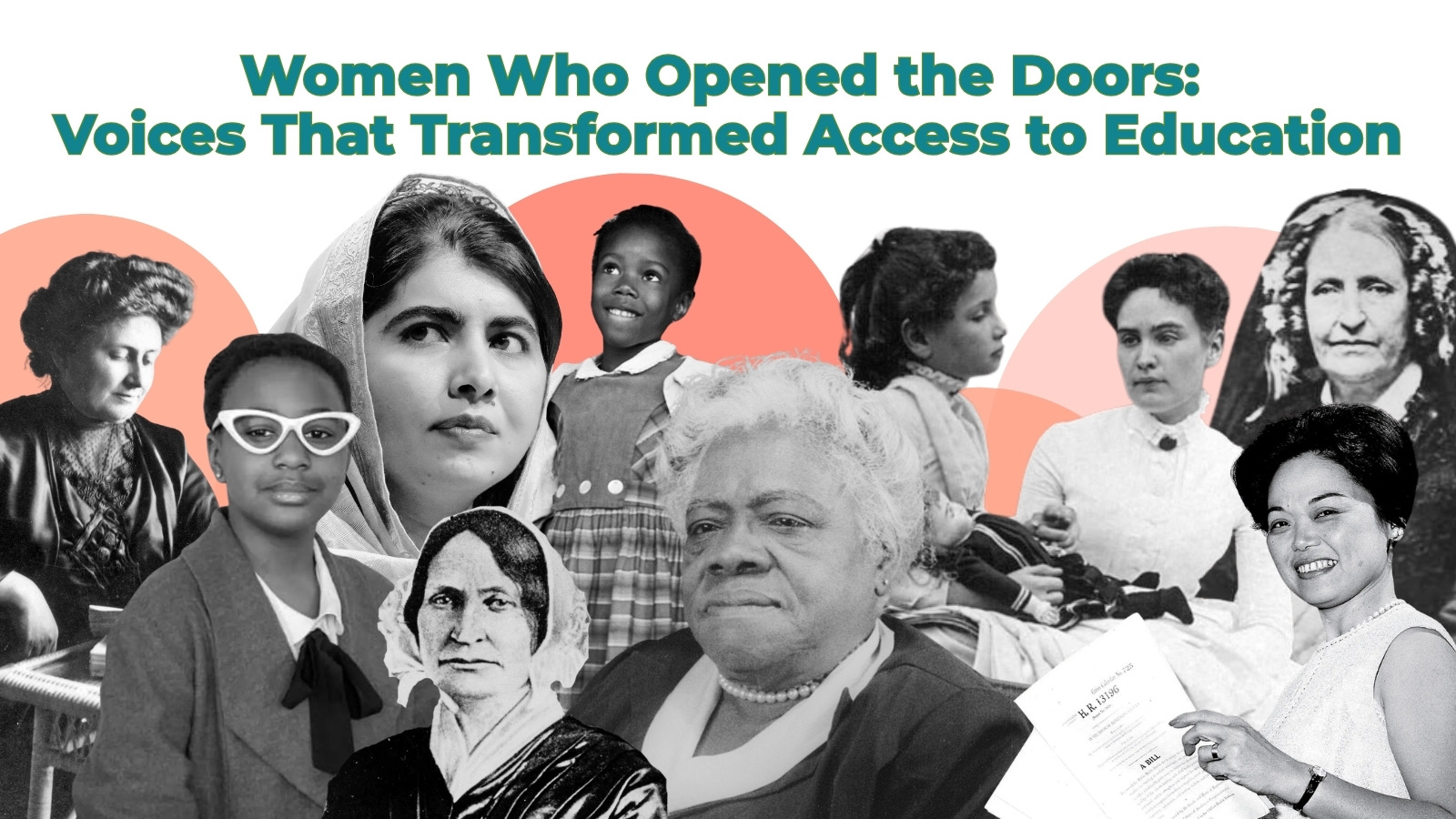
A Women’s History Month Reflection from the Freedom to Read Project
Every generation inherits the freedoms that previous generations fought to secure. When it comes to education, many of the rights we take for granted today—girls attending school, women enrolling in universities, students with disabilities receiving an education, and classrooms becoming more inclusive—exist because courageous women raised their voices and refused to accept the barriers placed before them.
For Women’s History Month, the Freedom to Read Project celebrates the women who transformed education by insisting that knowledge must not belong to only a few. Their stories remind us that access to books, classrooms, and ideas has never been automatic. It has been won through persistence, advocacy, and often extraordinary bravery.
From pioneering educators in the 19th century to modern activists defending girls’ education around the world, these women changed the trajectory of learning for millions.
Emma Hart Willard: Opening the Doors to Women’s Higher Education
In the early 1800s, higher education in the United States was largely reserved for men. Women were expected to focus on domestic roles, and formal academic instruction beyond basic schooling was rare.
Emma Hart Willard (1787–1870) challenged that assumption.
Believing that women deserved the same intellectual opportunities as men, Willard wrote a groundbreaking proposal to the New York State legislature arguing that educating women would strengthen society as a whole. While the legislature did not initially fund her idea, she persisted.
In 1821, Willard founded the Troy Female Seminary, the first endowed institution for women’s higher education in the United States. Unlike finishing schools of the time, her curriculum included mathematics, philosophy, science, and history, subjects traditionally reserved for men.
Willard’s work helped establish the idea that women’s intellectual potential was equal to men’s. Her model inspired dozens of women’s academies and laid the groundwork for women’s colleges that would emerge later in the century.
Mary McLeod Bethune: Education as a Path to Freedom
Few stories illustrate the transformative power of education more than that of Mary McLeod Bethune (1875–1955).
Born to parents who had been enslaved, Bethune understood firsthand how education could change lives. In 1904, she opened the Daytona Educational and Industrial Training School for Negro Girls in Florida with just five students and $1.50.
Bethune believed deeply that education was the foundation for freedom and self-determination. Through tireless fundraising and advocacy, her school grew and eventually merged with Cookman Institute to become Bethune-Cookman University, one of the nation’s historically Black colleges and universities (HBCUs).
Beyond education, Bethune served as a national civil rights leader and advisor to President Franklin D. Roosevelt. But her central mission never changed: expanding educational opportunities for Black Americans who had long been denied it.
Her legacy continues today in the thousands of students educated at institutions she helped build.
Ruby Bridges: Courage in the Face of Segregation
In 1960, six-year-old Ruby Bridges (1954–present) walked into William Frantz Elementary School in New Orleans and made history.
She became the first African American child to desegregate an all-white elementary school in the South.
Ruby’s walk to school required federal marshals for protection. Crowds gathered outside shouting threats. Many white families withdrew their children from the school, leaving Ruby as the only student in her classroom for much of the year.
Yet Ruby showed up every day.
Her bravery helped enforce the Supreme Court’s decision in Brown v. Board of Education and demonstrated that access to education should not depend on race.
Today, Ruby Bridges continues to advocate for racial justice and education through the Ruby Bridges Foundation, reminding new generations that the fight for equitable schools is ongoing.
Patsy Mink: Writing Equality into Law
For decades, women faced widespread discrimination in education. Colleges limited female enrollment, academic programs excluded women, and athletics opportunities were drastically unequal.
Patsy Mink (1927–2002) helped change that.
As a U.S. congresswoman from Hawaii, Mink co-authored Title IX of the Education Amendments of 1972, landmark legislation prohibiting sex discrimination in federally funded educational programs.
Title IX transformed American education. It opened doors for women in academic programs, scholarships, and athletics, dramatically expanding opportunities for girls and women in schools and universities. It also offered protections for non-binary and transgender people.
Today, millions have benefited from the anti-discrimination gender protections that Mink helped make into law.
Helen Keller: Education Without Barriers
At a time when people with disabilities were often excluded from formal education entirely, Helen Keller (1880–1968) shattered expectations.
After losing her sight and hearing as a young child, Keller learned to communicate through the guidance of her teacher Anne Sullivan. Her determination led her to become the first deaf-blind person to earn a Bachelor of Arts degree, graduating from Radcliffe College in 1904.
Keller spent her life advocating for disability rights, accessible education, and social justice. She argued that educational access should extend to everyone, regardless of physical ability.
Her story continues to inspire educators and students alike, demonstrating that learning is a universal human right.
Malala Yousafzai: A Global Voice for Girls’ Education
In the 21st century, the fight for educational access continues around the world.
Malala Yousafzai (1997–present) became a global symbol of courage when she spoke out against the Taliban’s ban on girls’ education in Pakistan. At just 15 years old, she survived an assassination attempt for advocating that girls should be allowed to attend school.
Rather than silencing her, the attack amplified her message.
Malala went on to become the youngest Nobel Peace Prize laureate in history and founded the Malala Fund, which works globally to ensure girls can access twelve years of free, safe, quality education.
Her advocacy reminds the world that millions of girls still face barriers to education and that the fight for access continues.
Additional Women Who Expanded Educational Access
Women’s advocacy for education spans centuries and continents. Many others played critical roles in advancing equal access to learning.
Mary Lyon (1797–1849)
Mary Lyon founded Mount Holyoke Female Seminary (now Mount Holyoke College), one of the first institutions to offer rigorous higher education to women. Her model helped demonstrate that women could excel in academic study.
Septima Poinsette Clark (1898–1987)
Often called the “Mother of the Civil Rights Movement,” Clark developed literacy and citizenship schools that helped African Americans learn to read and pass voter registration tests during the Jim Crow era.
Education, she believed, was essential for democracy.
Anne Sullivan (1866–1936)
As Helen Keller’s teacher and lifelong mentor, Sullivan pioneered innovative educational methods for teaching students with disabilities. Her work reshaped expectations about what disabled students could achieve.
Maria Montessori (1870–1952)
An Italian physician and educator, Montessori revolutionized early childhood education through the Montessori method, emphasizing student independence, curiosity, and hands-on learning.
Her educational philosophy continues to shape classrooms worldwide.
Why These Stories Matter Today
The women highlighted here lived in different eras and faced different barriers, but they shared a common belief:
Education should not be restricted by gender, race, disability, or circumstance.
Their efforts helped dismantle systems that limited who could learn, who could teach, and who could participate in public life.
Yet history also shows that access to knowledge can never be taken for granted.
Across the United States today, debates over books, curriculum, and educational access remind us that the freedom to read and learn continues to require vigilance. The ability to explore ideas, encounter diverse perspectives, and learn from history is central to a healthy democracy.
The women who fought for educational equality understood something fundamental: when people have access to knowledge, they gain the power to question injustice, imagine new possibilities, and build a more inclusive future.
Continuing the Work
Women’s History Month is not only a time to celebrate the achievements of the past. It is also a reminder that the work of protecting educational access belongs to every generation.
These women’s legacies call us to continue defending the principles they fought for:
- Equal access to education
- The freedom to explore ideas
- The belief that knowledge belongs to everyone
When we protect the freedom to read and learn, we honor the generations of women who opened the doors before us and ensure those doors remain open for the students who will walk through them next.