The Librarians Won an Emmy. The Fight It Documents Is Far From Over.
The Librarians won an Emmy, but escalating censorship and attacks on libraries show the fight for intellectual freedom continues nationwide.
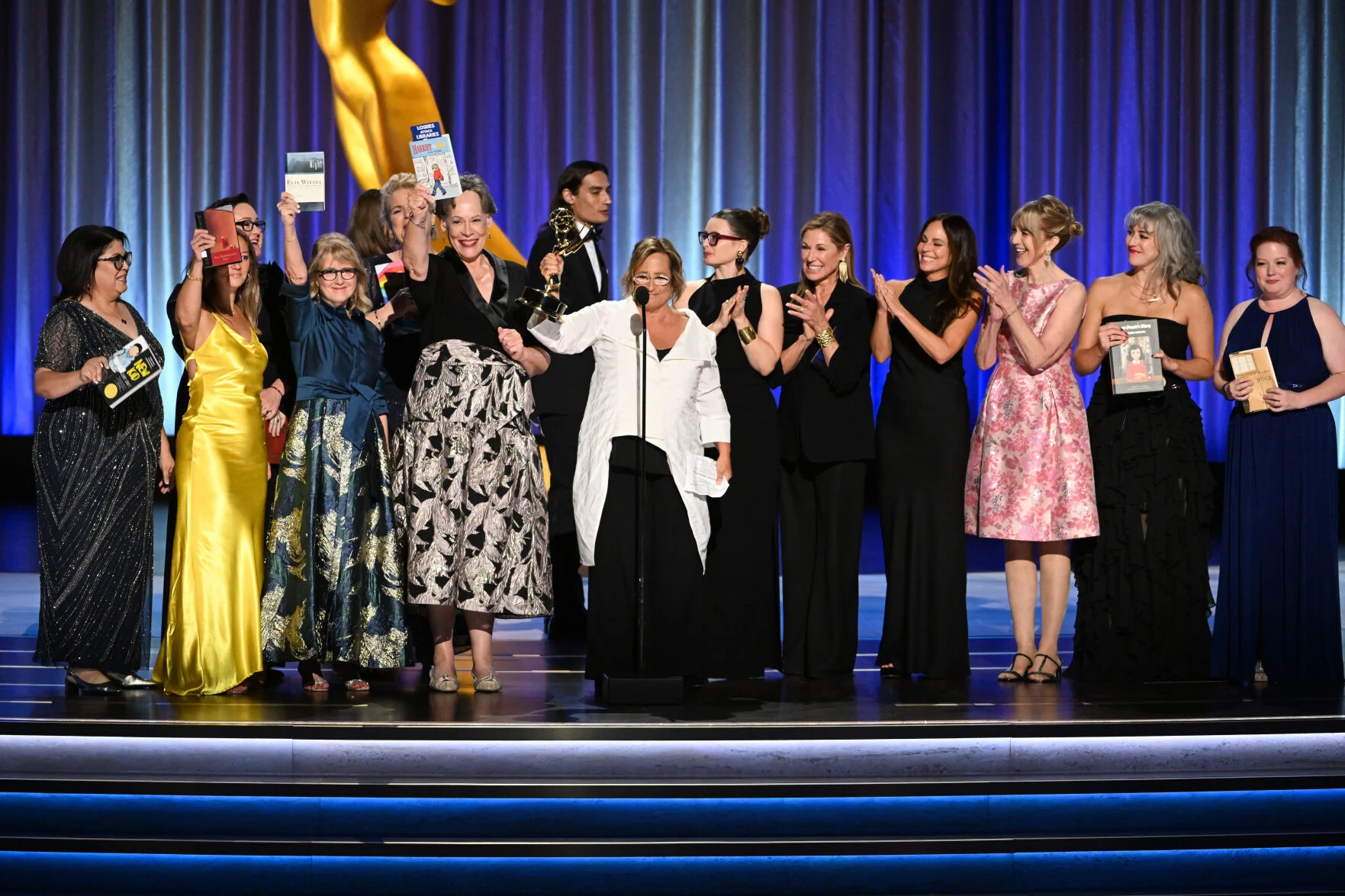 This weekend, The Librarians won the Emmy for Exceptional Merit in Documentary Filmmaking, a well-deserved recognition for a film that has helped bring the reality of modern book censorship to audiences across the country.
Directed by Kim A. Snyder, the documentary follows librarians who found themselves on the front lines of an organized effort to restrict access to books, particularly those dealing with race and LGBTQIA+ identities. It shows what happens when the people whose jobs are to connect readers with information suddenly find themselves facing angry meetings, accusations, political pressure, harassment, and laws that threaten the work they have been trained to do. On September 5, the Television Academy honored the film with the Emmy for Exceptional Merit in Documentary Filmmaking. (Television Academy)
If you haven't watched it yet, now is the time. The full documentary is currently available to watch for free through PBS, including on the PBS YouTube channel, but the PBS streaming window ends September 14. After that, the film will become available to rent or buy digitally beginning October 6, including on Apple TV. (PBS)
The Emmy is worth celebrating. So are the librarians whose courage made the documentary possible. But perhaps the most important thing we can do to honor both is recognize that The Librarians is not a story about something that happened. It is a story about something that is still happening.
Six Banned Books Weeks Later
This October 4–10, we will recognize another Banned Books Week under the shadow of the current censorship movement. The 2026 theme, appropriately, is "Let Books Be. Protect the Freedom to Read." (American Library Association)
For those of us who have been working in this space since the current wave of book challenges began around 2021, there is something sobering about that anniversary. We are approaching our sixth Banned Books Week since this movement took hold.
Six years of challenges. Six years of packed school board meetings. Six years of lists circulating from district to district and state to state. Six years of librarians and educators being accused of harming children simply for making books available to them. Six years of legislation, new review procedures, restricted shelves, parental-permission systems, state-mandated removals, and books quietly disappearing while communities struggle to keep track.
And the evidence increasingly makes clear that this has never simply been a spontaneous uprising of individual parents concerned about books their own children were reading.
According to the American Library Association's latest data, 92 percent of book challenges in 2025 came from pressure groups, government officials, and other decision makers. Fewer than 3 percent came from individual parents. ALA recorded 4,235 unique titles challenged during the year, the second-highest number it has ever documented. (American Library Association)
That distinction matters.
Parents absolutely have a right to guide the reading choices for their own children. They can urge their child not to check out a particular book. They can discuss what their family believes. They can ask questions about what their child is reading.
But organized censorship is something different. It seeks to turn one person's objection into a restriction for everyone else's family.
We recently explored exactly that problem in When One Objection Becomes Everyone's Problem. Increasingly, a challenge that begins in one community can affect readers hundreds of miles away, including families who were never given an opportunity to participate in the decision.
The Target Has Grown
Perhaps the most important reason to watch The Librarians now is that the movement depicted in the film has not remained static. It has expanded.
Earlier censorship efforts frequently centered on individual titles. Today, we are seeing battles over entire library systems, governance structures, funding, collection policies, displays, programming, and who ultimately gets to decide what information a community can access.
PEN America's newly released report, Out of Circulation, documents this shift in public libraries. The report describes interference with book displays, disruptions of events, changes to library governance, defunding threats, and harassment and intimidation directed at librarians who resist censorship. (PEN America)
We warned about this evolution recently in Beyond Book Bans: When the Target Becomes the Library Itself. Once a library is portrayed primarily as a source of controversy rather than a vital public institution, attacking its funding, independence, or very existence becomes much easier.
We are also seeing censorship become less visible.
Books may be removed "temporarily" while awaiting reviews that stretch on indefinitely. Professional weeding practices can be manipulated to quietly eliminate controversial titles. Fear of complaints can influence purchasing decisions before a book ever reaches a shelf.
As we discussed in When "Temporary" Becomes Permanent, censorship does not always arrive with a dramatic school board vote and a headline announcing that a book has been banned. Sometimes access simply disappears. And increasingly, the authority to make these decisions is moving farther away from the communities affected by them.
In our most recent article, When "Government Speech" Does Not Mean Your Local Government, we examined how state and potentially federal authority can override decisions made by librarians, educators, review committees, parents, and locally elected school boards. The question is no longer simply, "Should this book be banned?" Increasingly, the question is: Who gets to decide what the rest of us are allowed to read?
Banned Books Week Cannot Be the Only Week We Care
Banned Books Week has always served an important purpose. It brings attention to censorship, celebrates books that have survived attempts to suppress them, and reminds communities that intellectual freedom requires protection.
But after six years of sustained censorship efforts, putting up a banned-books display once a year is not enough. The people working to restrict books do not organize for one week in October. Neither can we.
Supporting the freedom to read can begin with surprisingly small actions. Pay attention to your local school and library boards. Read their agendas. Thank librarians and educators who defend inclusive collections. Speak during public comment. Contact elected officials when legislation affecting libraries or education is introduced. Write a letter to the editor when censorship comes to your community.
Our guide, How to Write a Powerful Letter to the Editor or Op-Ed on Book Bans, walks readers through one way to turn concern into public advocacy.
You can also support targeted books directly. Buy them. Borrow them. Review them. Recommend them to book clubs. Donate copies where appropriate. Our article on Consumer Activism in the Age of Book Bans explains how ordinary readers can use their purchasing, reviewing, and community engagement to help keep challenged stories visible.
Most importantly, don't wait until a book you love disappears. Censorship succeeds more easily when the people who support libraries assume someone else will defend them.
Watch. Then Act.
The Emmy for The Librarians is a victory worth celebrating. It means this story reached beyond school board rooms, library conferences, advocacy organizations, and the communities already living through these fights. It means librarians who were vilified for doing their jobs have now had their experiences recognized on one of television's biggest stages.
That matters.
But the best way to celebrate The Librarians is not simply to applaud the film. It is to listen to what the librarians in it have been trying to tell us.
The freedom to read is not self-sustaining. Libraries do not remain open, independent, diverse, and accessible simply because they always have been. Those institutions survive because communities value them, fund them, defend them, and speak up when someone tries to undermine them.
So before the free PBS streaming window closes, watch The Librarians. Send it to someone who still thinks book bans are isolated disputes about a few controversial titles. Talk about it. Share what you learned.
Then, when Banned Books Week arrives in October, don't treat it as a commemoration of a battle that has already been fought. Treat it as a reminder of the work still ahead. Keep it in mind when you go to vote in November. When those that want to ban books are arguing that our libraries are “government speech,” the freedom to read is on the ballot.
Watch The Librarians free on PBS through September 14
Learn about The Librarians and its October 6 digital release
Photo: Phil McCarten